
Our demands for the 5th Feminist Foreign Policy Ministerial
Feminist Foreign Policy (FFP) is at a critical crossroads. Political commitments and declarations have increased in recent years, but without real changes in how resources are mobilized, allocated, and managed, these commitments will not deliver on gender equality.
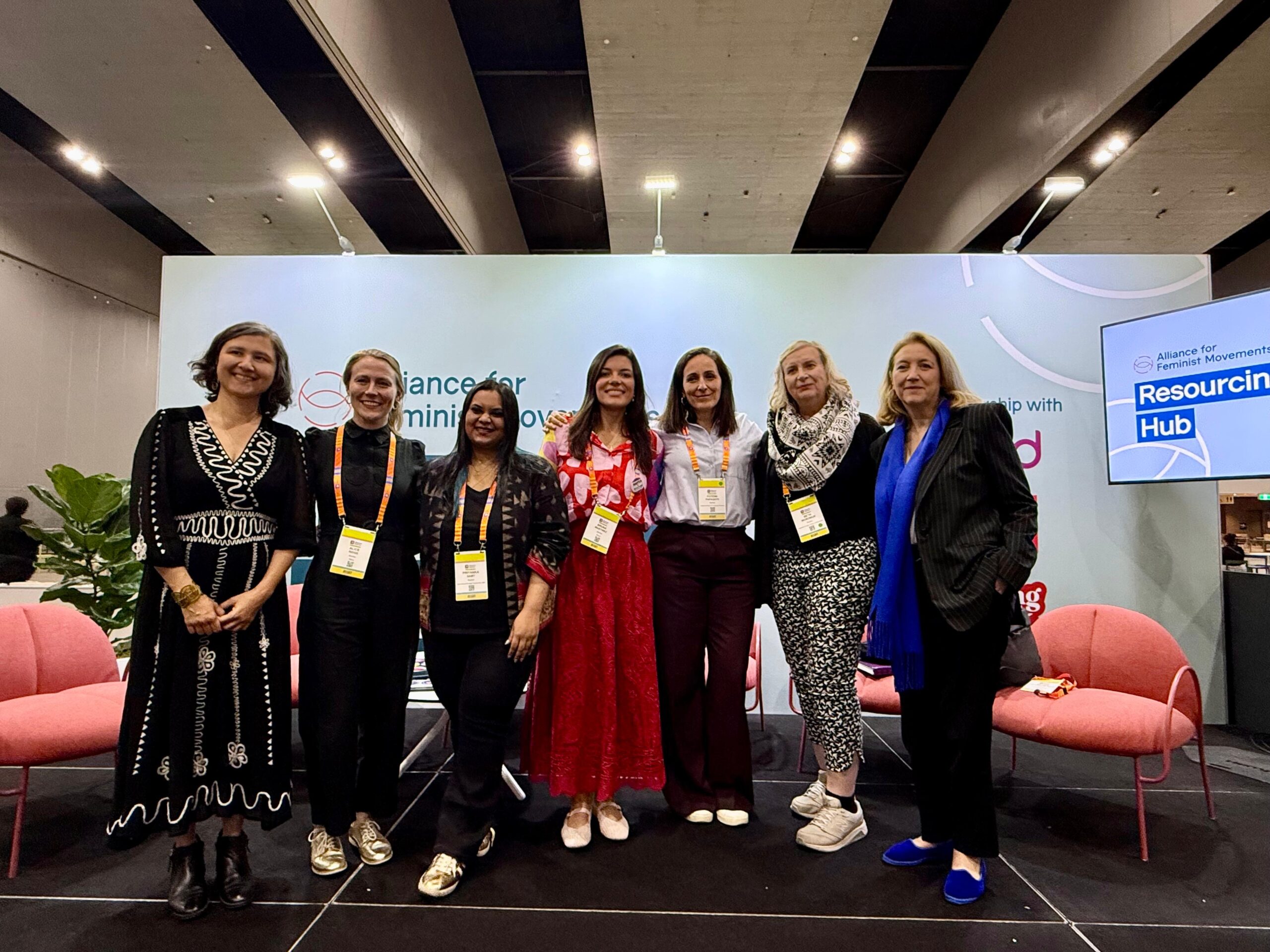
This framing is precisely what guided the session, “Making Way for Feminist Financing in Feminist Foreign Policy,” at Women Deliver 2026 in Narrm (Melbourne). In what follows, we share some key takeaways and priorities that came up from the discussion as we prepare for the 5th Feminist Foreign Policy Ministerial in Madrid.
Alice Ridge, Senior Research, Policy & Advocacy Advisor at the International Women’s Development Agency – IWDA, moderated the session. Instead of just reaffirming commitments, the group tackled a tougher but necessary question: what will it take to turn those commitments into real financial change? By focusing on both policy realities and the demands of feminist and gender equality actors, Alice guided the conversation toward what needs to change in practice – in terms of implementation of commitments and accountability.
Looking back at the 4th FFP Ministerial hosted by France, Delphine O, former French Ambassador and Secretary General of the 4th FFP Ministerial, pointed out a key tension. FFP has built momentum and broad political coalitions, but it has not yet changed the systems that govern resource distribution. As Bruna Martinez (Program Manager, Walking the Talk at Hivos) said, “without structural economic reform and direct, flexible funding for feminist movements, feminist foreign policy risks remaining declaratory rather than transformative.”
Beth Woroniuk, Senior Fellow, Feminist Foreign Policy Collaborative and Board Member at Prospera – INWF, spoke from the perspective of feminist funding intermediaries. She emphasized that the problem is not a lack of solutions, but a lack of scale and political will. There are already ways to fund feminist movements, and many of them work. However, these efforts are still fragmented, inconsistent, and underfunded. With development budgets shrinking, her call was for governments to at least protect and secure what already exists, and also look beyond Official Development Assistance (ODA) to consider all economic policies that affect funding for gender equality.
Foteini Papagioti, Director of Policy & Advocacy at ICRW, pushed the discussion further. Instead of focusing only on finding new money, she called for greater attention to how financial systems themselves are structured, and who they serve. She also pointed to concrete entry points where this shift can begin. On one hand, the potential of the Sevilla Platform for Action (SPA) initiatives. On the other, the recently launched Debt Borrowers’ Platform at the 2026 ECOSOC Forum on Financing for Development Follow-Up (FfD Forum), for example, is creating space for debtor countries to coordinate and amplify their collective voice. The growing recognition of the intergenerational and gendered impacts of debt presents an opportunity to connect these directly to gender equality outcomes. Reflecting on what these openings bring, Foteini highlighted that, for Spain, as both the host of the FfD process and the upcoming FFP Ministerial, this presents a clear window to align these agendas and advance more coherent, gender-responsive approaches to debt and economic governance.
Priyanka Samy, Global Lead on Gender & Intersectionality at the International Budget Partnership (IBP), shared this broader, systemic view. She pointed out that macroeconomic challenges, especially in the Global South, continue to stall progress. Debt, unfair tax systems, corporate influence, and ongoing underinvestment in care are central to achieving feminist commitments. If FFP wants real impact, it must address these structural problems head-on.
A pivotal moment for the implementation of these points is the upcoming 5th FFP Ministerial, presenting an opportunity to connect political goals with real financial change, but only if governments go beyond words and make concrete decisions. As H.E. Esther Monterrubio Villar, Ambassador of Spain to Australia, said in the session, today’s political climate calls for clarity, ambition, and action.
Four priorities governments must take seriously at the 5th FFP Ministerial
1. Protect and scale funding for feminist movements
Governments must ring-fence and expand core, flexible, multi-year funding for feminist movements and feminist funds. The infrastructure already exists. Feminist movements have long been building and sustaining effective models of solidarity, redistribution, and accountability, despite chronic underfunding.
2. Commit to economic transformation that enables gender equality: Austerity, illicit financial flows, and unjust debt systems, which are business-as-usual economic policies, produce and deepen gender inequality. Governments must advance progressive taxation, support debt restructuring and cancellation where needed, and protect public spending that sustains life and collective wellbeing.
3. Finance care systems at scale: Recognize care as a principle that sustains life, and commit to large-scale public investment in care systems as a foundation for gender equality, the functioning of all societies, and the well-being of people and planet.
4. Center accountability and real inclusion: Accountability remains one of the greatest unresolved tensions within FFP. Governments must commit to transparent monitoring, measurable targets, public reporting, and meaningful participation and leadership of feminist movements in financial decision-making processes.
As we move from Narrm to Madrid, together with feminist movements, civil society, and allied governments, we are calling for more than declarations: we are demanding structural shifts in how resources, power, and decision-making are organized and governed. Only then can feminist foreign policy begin to deliver on its promises.